
Infinitely Scale Your Business
Have you ever wondered how some companies succeed in growing new lines of business like magic? One of the latest examples is Amazon’s hot new natural language interaction business, known as Alexa. Alexa let’s users not only shop online, but also lets them automate many other things. Alexa skills, the catalogue of automated interactions, grew from 7000 skills in January 2017 to over 15.000 in June 2017. Going from a successful local test with one skill to full-blown nation-, soon worldwide operations in just a few months is an impressive feat. Doing it with thousands more at the same time is outstanding. Of course, global companies like Amazon already have lots of resources available from existing lines of business. So in theory, they only need to organize support for the new line of business in these existing structures, right? Isn’t this easy?
As a matter of fact, it’s not. Structures in most businesses are there for a single purpose: to support and protect exactly the existing line of business. Over time, this structure is optimized more and more, resulting in being hardwired to the dedicated business case. Re-organizing even a small part of such structures to support a new line of business is difficult and time-consuming. It can not be done without bringing in additional resources dedicated to the new business. The amount of required resources greatly depends on the intended operational scale of the new business. While a local business can be operated with a small staff, worldwide operations require hundreds and thousands of employees. Right-sizing new operations is best done while slowly expanding the business. This way, it is possible to achieve a profitable balance between the amount of resources required to satisfy growing market demand. Jumping into global operations very fast requires an explosive build-up of resources, significantly increasing the risk of wrong-sizing operations.
Some years ago, this logic applied also to Amazon. But then, Amazons CEO Jeff Bezos decided to turn his whole company into a fully digitally enabled business; one that could scale business operations and easily connect them with each other without adding much resources. What he did in 2002 was unprecedented, as disclosed by a former employee (1). He ordered his whole company, every single unit within it, to operate as a business service. Plus, every business service had to develop standards for digital communication to offer and deliver value-add in the Amazon service ecosystem. Plus, all other ways of communication and transaction management between business units had to be shut down. It sounded crazy at the time.
15 years later, businesses around the world feel the impact of this decision. Amazon now is an ecosystem of businesses held together by a super-fast, super-efficient digitally connected framework of standardized, yet autonomous services. This framework can run billions of transactions in a completely automated fashion. It can easily integrate and connect value streams inside its ecosystem. Businesses inside the ecosystem can quickly and without much additional resources share their capabilities to test any promising new business opportunity. It doesn’t matter if their digital service interfaces process one request per hour or millions. They don’t need to care much about managing the scale of new operations. Many activities that were formerly required to manage the growth of operations are completely unnecessary in their world. With limited resources, they can scale business operations infinitely.
This characteristic is one of the many benefits of business platforms. Jeff Bezos was very early to understand the power of digital platforms for business. As a pioneer in this field, it took Amazon many years to figure this out. In today’s world of business, platforms are emerging everywhere. But few businesses are going all in like Amazon – transforming the whole company into an ecosystem of business services. The ones who do it will be richly rewarded.

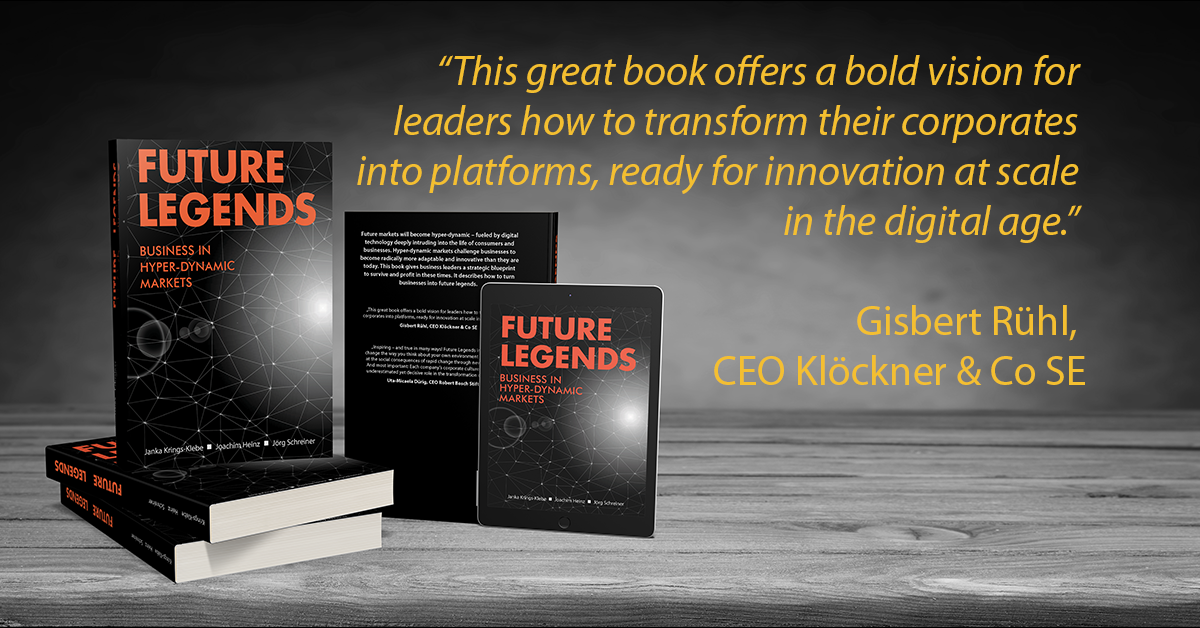
We expect them to become future legends in their field, as described in our book FUTURE LEGENDS – Business in Hyper-Dynamic Markets.
Notes:
Blog image: pexels.com